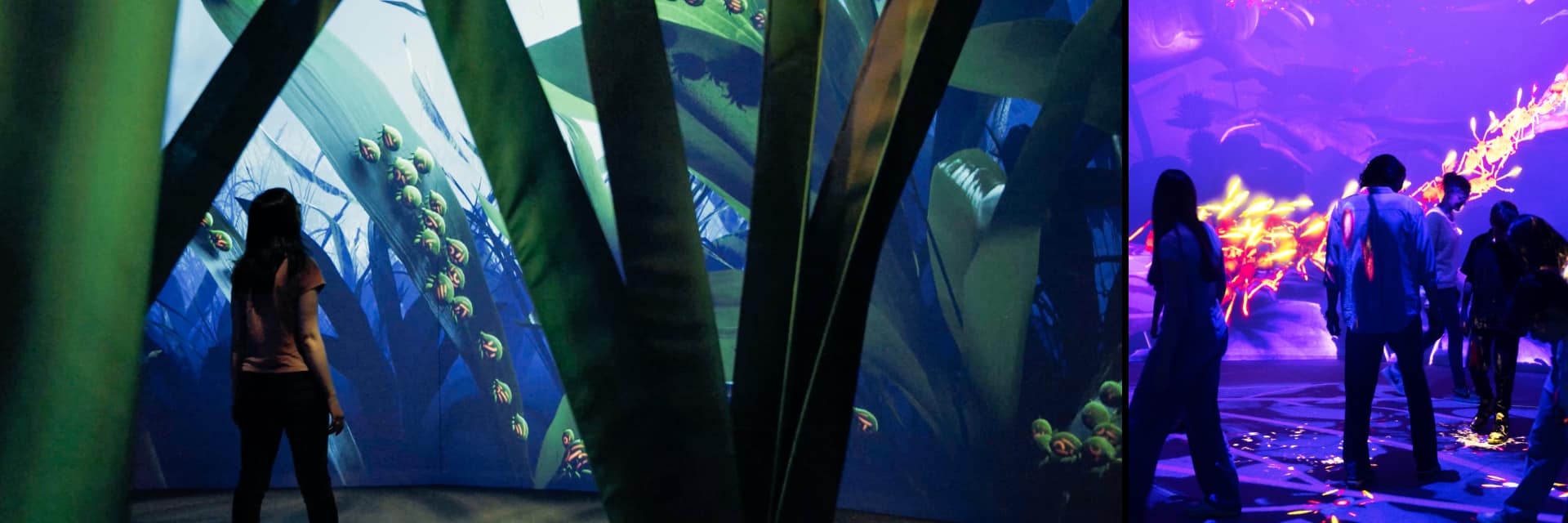

Created within 950 square metres of exhibition space, with an intricate system of 35 projectors, 65 speakers and audience position sensing, Antopia explores how complex scientific ideas can be communicated in ways that captivate and inspire audiences of all ages. The entire space is interactive, with precisely located sonic elements providing spatialised feedback for physical interactions and an immersive mix for the score.
The experience centres around five different zones that visitors are free to explore at any time. Each zone has its own visual and musical identity, but none of them are acoustically separated. This gave us an interesting provocation to work with. How do you create five distinct sonic environments within one large, open space without them competing with one another?
Our solution had four main parts.
First, we synchronised the entire space. Every element of the background score, sound effects, and featured music elements were synchronised in tempo, key and harmony. We divided the 33-minute dwell time into six five-minute pieces and a three-minute storm sequence that acted as a reset. Each piece had a different harmonic structure, but all related to one another, so visitors could move freely through the exhibition without anything ever feeling out of place.
Next, taking cues from score writing for computer games, Brendan composed the background score so that it could play out differently in each zone. This involved creating a large selection of instrumental variations that could be mixed and matched to suit the mood of each space. Different musical elements were placed throughout the exhibition using immersive audio panning, allowing the score to shift around visitors as they explored.
Third, Brendan wrote a series of shorter feature pieces for the Queen Ant interactive. This is a musical game that needed to fit into the rest of the experience like a giant audio jigsaw puzzle. These pieces followed the score’s exact harmonic structure, so it was necessary to write a different feature piece for each of the five-minute segments.
Finally, we created all the interactive sounds in every key used throughout the experience. Our custom audio media server could then select sounds appropriate to the music playing at that moment. With hundreds of interactive musical sound effects on hand, this was quite an undertaking, but well worth the effort.
Brendan directed the creation of the interactive audio elements by the team at Klang Studios and built the audio playback and control system. This included designing an OSC communications dictionary connecting the video and interactive systems, running through Unreal servers, with the custom audio media server. Across the completed experience, some 6,000 cues, a large number of scripts and many hours of testing brought all of the moving parts together.
The project culminated in a very tight three-week commissioning period in Melbourne. During that time, every element of the audio was integrated with the show-control systems, balanced and placed within the space. Careful planning kept the 65 speakers out of sight—sometimes behind projection surfaces, sometimes suspended from the ceiling—while ensuring the interactive sounds appeared to come directly from the actions and objects visitors encountered.

Production Co: S1T2
Music composition and Sound Design: Brendan Woithe
Audio Implementation: Brendan Woithe